Executive Summary
AI change management is not a communication exercise. It is the discipline of turning artificial intelligence from individual experimentation into governed, measurable and scalable human-AI work.
That distinction matters in financial services.
A bank can deploy copilots, workflow assistants, document intelligence, model-based decision support, fraud analytics, knowledge-management tools and generative-AI interfaces. But deployment does not mean adoption. Adoption does not mean productivity. Productivity does not mean enterprise value. And enterprise value does not exist unless the workflow, decision process, risk control and operating model change in a measurable way.
For financial institutions, AI change management must connect five domains: business value, workflow redesign, human-AI interaction, governance and regulatory readiness.
The regulatory dimension is already concrete. Article 4 of the EU AI Act requires providers and deployers of AI systems to take measures to ensure a sufficient level of AI literacy among staff and other persons using AI systems on their behalf. The European Commission states that Article 4 entered into application on 2 February 2025, while supervision and enforcement rules apply from 3 August 2026 onwards.
That does not make AI change management a training box to tick. It makes it a management obligation.
A mature AI change approach should be able to answer four questions:
- 01What work will change?
- 02Which people need which level of AI literacy?
- 03How will human judgement, trust, oversight and accountability be designed?
- 04How will the institution evidence that AI improves outcomes without weakening control?
The strongest AI transformations will not be those with the most tools. They will be those with the clearest operating model for human-AI work.
Why AI Change Management Is Different
Traditional change management often starts with communication, stakeholder engagement, training and adoption tracking.
Those elements still matter.
But AI changes the nature of the change.
A new workflow system usually changes how people enter, process or retrieve information. AI changes how people interpret information, make judgements, delegate tasks, trust outputs, challenge recommendations and document decisions. It affects not only process execution, but decision behaviour.
That makes AI change management more complex than a standard technology rollout.
The technology is probabilistic. Outputs can be useful without being fully reliable. The same tool can improve one task and weaken another. The system may behave differently across use cases, user groups, data contexts and control environments. The human user is not simply adopting software. The user is entering a new decision relationship with a machine.
This is why classic change-management thinking remains useful but insufficient.
Lewin's basic insight that change requires movement from an existing state into a new behavioural state remains relevant. Kotter's emphasis on leadership, coalition-building and anchoring change remains relevant. ADKAR's focus on awareness, desire, knowledge, ability and reinforcement remains relevant. But AI adds a further layer: the organisation must design appropriate human reliance on systems that can assist, mislead, accelerate, simplify, overstate confidence or hide complexity.
AI change management is therefore not only about moving people from old tools to new tools.
It is about moving the organisation from informal AI use to governed AI-enabled work.
The Misunderstanding: Adoption Is Not Change
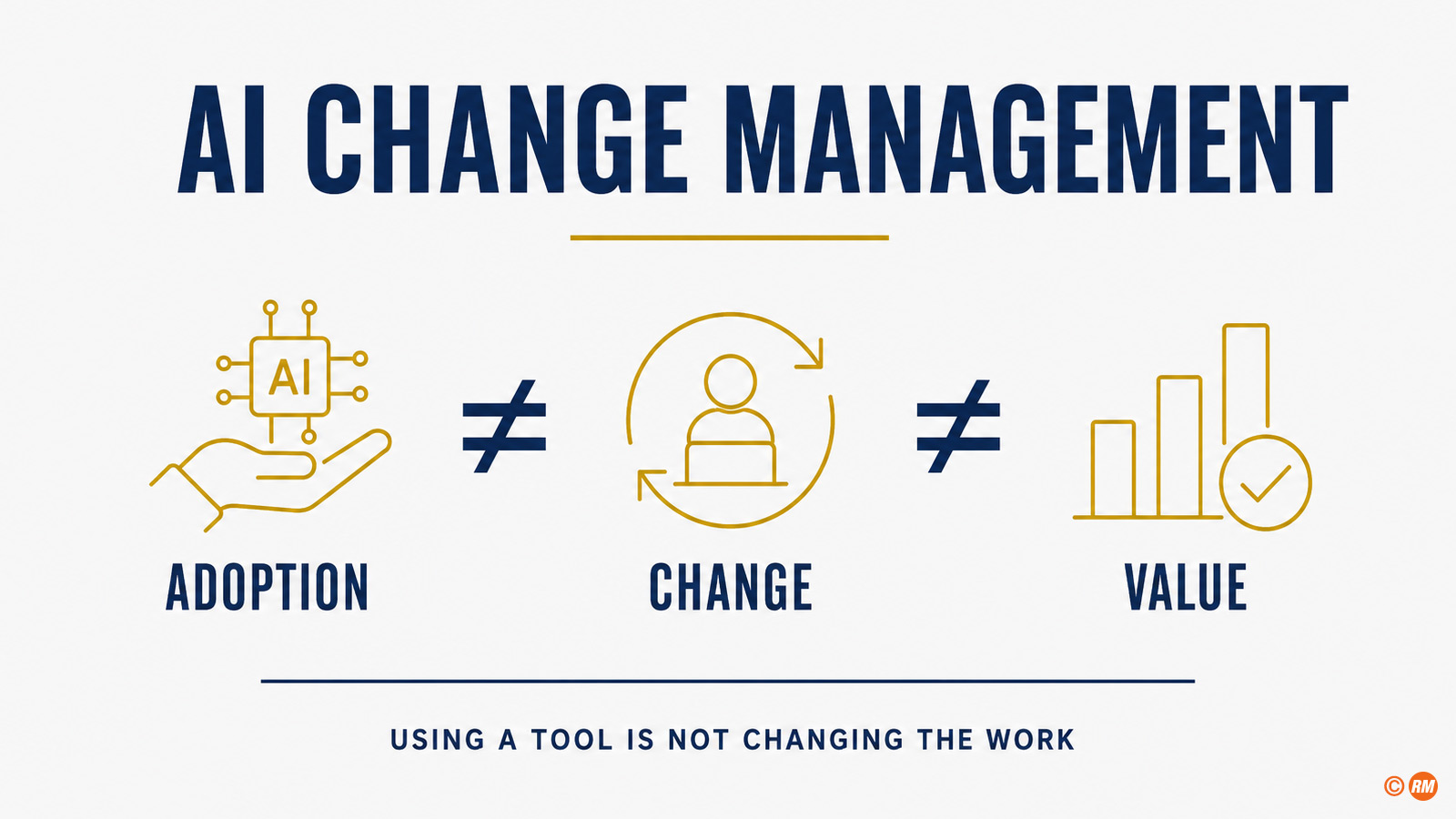
A common management mistake is to treat AI adoption as the main success metric.
Usage is visible. Licences are countable. Training attendance is easy to report. Prompt libraries can be published. Communities of practice can be launched. None of this is irrelevant. But none of it proves that meaningful change has happened.
Adoption is an input.
Change is a behavioural and operational shift.
Value is an outcome.
Decades of adoption research help explain why people use systems. Davis's Technology Acceptance Model focused on perceived usefulness and perceived ease of use. UTAUT expanded the adoption lens to include performance expectancy, effort expectancy, social influence and facilitating conditions. Markus's work on technochange makes the deeper point: technology implementation and organisational change are not the same thing. A system can be accepted and still fail to change work in the way the organisation needs.
That is highly relevant for AI.
A financial institution may see high usage of AI tools without measurable improvement in cycle time, decision quality, risk detection, control effectiveness or customer experience. Employees may use AI for drafting, summarising or searching, while the underlying workflow remains unchanged. In that case, AI may reduce individual effort but fail to change enterprise performance.
The stronger question is not:
How many people are using AI?
The stronger question is:
Which workflows have changed because of AI, and what evidence shows that the change improved the outcome?
That question shifts AI change management from activity reporting to value governance.
This also protects against a second mistake: assuming that AI resistance is irrational. People may resist AI because they do not understand it. They may also resist it because they understand the operational risk very well. They may be concerned about accountability, accuracy, rework, job impact, auditability, customer consequences or unclear decision rights.
Mature change management does not dismiss those concerns. It converts them into design requirements.
The Evidence: AI Can Improve Tasks, but Context Decides Value
The evidence on AI and work is promising, but it is not uniform.
Noy and Zhang found that access to ChatGPT reduced average completion time by 40% and improved output quality by 18% in professional writing tasks. Brynjolfsson, Li and Raymond found a 15% average productivity increase in a customer-support setting involving 5,172 agents, with stronger effects for less experienced and lower-skilled workers.
Those are important findings. They show that AI can create measurable task-level gains.
But the same body of evidence also argues against simple generalisation. Dell'Acqua and co-authors describe a "jagged technological frontier": AI improves performance for some knowledge-work tasks and worsens performance for others, even within apparently similar work. METR's 2025 randomized controlled trial found that experienced open-source developers working in mature repositories took 19% longer when allowed to use early-2025 AI tools; the authors present this as context-specific evidence, not a universal verdict on AI tooling.
That is the core lesson for AI change management.
AI change cannot be managed through generic enthusiasm. It must be managed through task classification, workflow evidence and operating-model design.
The practical implication is simple: before scaling AI in a function, the institution should know which tasks are inside the AI capability frontier, which tasks require human judgement, which tasks need review, which tasks should not be delegated, and which tasks create control or conduct risk if automated poorly.
That is not a technical detail. It is the foundation of responsible AI adoption.
The Regulatory Anchor: AI Literacy Is Now a Management Topic
AI literacy is often misunderstood as basic training.
In financial services, it should be treated as role-based competence.
Article 4 of the EU AI Act requires providers and deployers of AI systems to take measures, to their best extent, to ensure a sufficient level of AI literacy of staff and other persons dealing with the operation and use of AI systems on their behalf. The article explicitly refers to technical knowledge, experience, education, training, the context of use and the persons or groups on whom AI systems are to be used.
The Commission's AI literacy Q&A states that the obligation entered into application on 2 February 2025 and that supervision and enforcement rules apply from 3 August 2026 onwards. It also points to a living repository of AI literacy practices intended to support learning and exchange.
This is important for AI change management.
The obligation is not satisfied by one generic AI awareness course for everyone. The requirement is contextual. A board member, a software engineer, a model validator, a relationship manager, a financial-crime investigator, an operations analyst and an HR professional do not need the same AI literacy.
They need different competence profiles.
A board needs to understand value, risk appetite, accountability and evidence.
A business owner needs to understand workflow change, control impact and measurable outcomes.
A technology owner needs to understand architecture, data, security, monitoring and lifecycle management.
A risk or control function needs to understand model limitations, oversight, validation, evidence and escalation.
A front-line user needs to understand appropriate use, limitations, review obligations, confidentiality, data handling and when not to rely on the output.
That is the central shift.
AI literacy is not a classroom topic. It is part of the operating model.
ISO/IEC 42001 strengthens the same logic from a management-system perspective. The standard is designed for establishing, implementing, maintaining and continually improving an AI management system; its support requirements include competence and awareness as part of making AI governance operational.
DORA reinforces the broader principle that digital capability is not only technical. Article 13(6) of DORA requires financial entities to develop ICT security awareness programmes and digital operational resilience training as compulsory modules for staff and senior management.
For financial institutions, AI change management should follow the same logic: competence, awareness and resilience must be designed into the way work is performed.
The Human Factor: Trust Must Be Designed
Human-AI work depends on trust.
But trust is not the same as comfort. And it is not the same as adoption.
The automation literature has long shown that humans can rely too much on automation, too little on automation, or rely on it in the wrong situations. Bainbridge's "Ironies of Automation" remains relevant because automation can increase the importance of human oversight precisely when humans are moved further away from direct task execution. Lee and See describe trust as a key driver of reliance on automation, especially when complexity and uncertainty make full understanding difficult. Dietvorst, Simmons and Massey show that people may avoid algorithms after seeing them err, even when the algorithm outperforms human forecasters.
All of these effects matter in banking.
Over-trust can create automation bias. A user accepts an AI output because it looks structured, confident or efficient.
Under-trust can destroy value. A user ignores a useful model because one visible error damages confidence.
Distance from the work can also weaken judgement. If people no longer practise the underlying task, they may become less able to challenge the system when challenge matters.
The goal of AI change management is not to maximise trust.
The goal is appropriate reliance.
Appropriate reliance means that people understand when the AI system is useful, when it is uncertain, when it requires review, when it must be challenged and when it must not be used.
That requires design.
The user interface must show what the system is doing. The workflow must define review points. The policy must define permissible use. The training must explain limitations. The control framework must capture overrides. The feedback loop must show whether the system is improving or degrading.
Human-AI interaction research supports this design view. Amershi and co-authors developed guidelines for human-AI interaction, emphasising that AI systems should help users understand system capabilities, timing, uncertainty, feedback and correction mechanisms.
For financial institutions, this is not a user-experience detail.
It is a control requirement.
A Practical AI Change Management Framework
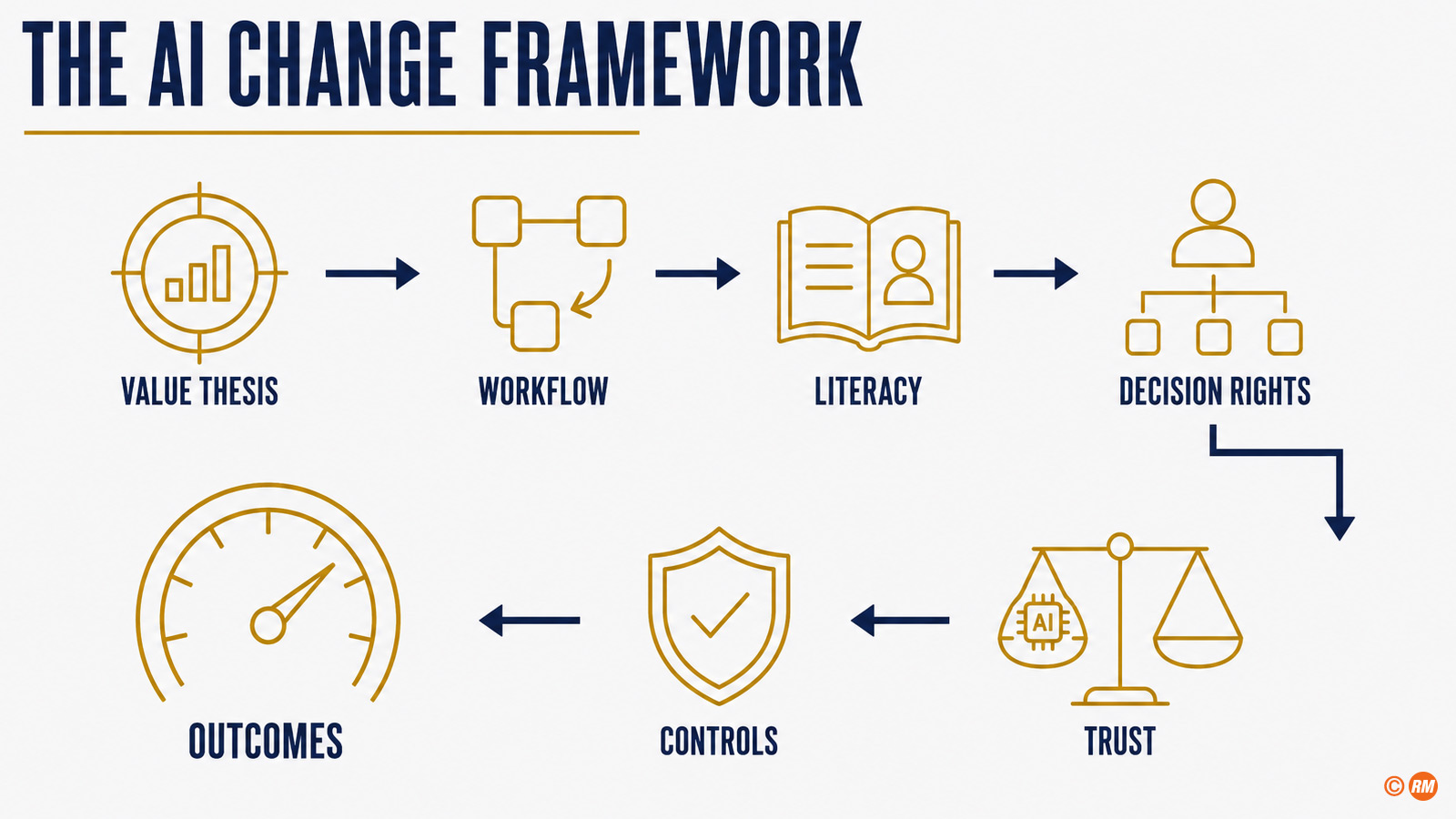
A useful AI change management framework for financial services should connect seven components.
01Value Thesis
Every AI change should begin with a value thesis.
What outcome should improve?
Examples include faster case preparation, lower rework, better customer response, improved control evidence, higher straight-through processing, stronger fraud detection, better knowledge retrieval or reduced manual effort in low-risk workflows.
The value thesis should be specific enough to measure.
WEAK"Use AI to improve productivity."
STRONGER"Reduce manual preparation time for recurring risk-reporting packs while preserving evidence quality and review accountability."
The second version can be tested.
02Workflow Redesign
AI should not be inserted into an old workflow without redesign.
A workflow needs to define which tasks remain human, which tasks are supported by AI, which tasks require review, which outputs are recorded, where accountability sits and how exceptions are handled.
If AI saves ten minutes in drafting but adds fifteen minutes of review, no value has been created. If AI speeds up one step while the bottleneck sits elsewhere, value may not reach the business outcome. If AI output is useful but cannot be documented, the control cost may outweigh the efficiency gain.
Workflow redesign is therefore not optional.
It is the conversion mechanism between AI capability and enterprise value.
03Role-Based AI Literacy
AI literacy should be segmented by role.
The board does not need prompt-engineering depth. It needs decision evidence.
The user does not need a legal treatise. The user needs practical understanding of appropriate use, limitations and escalation.
The model validator does not need motivational messaging. The validator needs technical evidence, performance behaviour, limitations, drift indicators and documentation.
The change programme should therefore define AI literacy personas:
- Board and senior management.
- Business owners.
- Technology and data teams.
- Risk, compliance and audit functions.
- Front-line users.
- Model validators and control owners.
Each persona needs a different training path, different evidence requirements and different practical exercises.
04Human Oversight and Decision Rights
AI change management must clarify who decides.
- Who may approve a use case?
- Who may use the tool?
- Who reviews outputs?
- Who may override the system?
- Who owns errors?
- Who owns model monitoring?
- Who decides whether the use case scales, pauses, changes or retires?
Without decision rights, AI adoption becomes informal. Informal AI use may be creative, but it is difficult to govern.
In financial services, decision rights are part of trust.
People need to know not only how to use AI, but also who is accountable when AI changes the work.
05Trust and Reliance Design
AI change management should explicitly design reliance.
This includes explaining the system's purpose, showing its limits, defining confidence boundaries, designing escalation points, capturing user feedback, tracking overrides and making review obligations clear.
The desired state is not blind trust.
It is calibrated trust.
Calibrated trust means users neither reject AI reflexively nor accept it mechanically. They use it where it improves the outcome, challenge it where judgement is required and avoid it where the use case is not appropriate.
06Control by Design
AI change should include risk and control functions from the start.
This does not mean every AI experiment needs the same level of governance. Proportionality matters. A low-risk internal drafting assistant does not require the same control model as a high-impact decision-support system.
NIST's AI Risk Management Framework supports this proportional, lifecycle-oriented view through functions such as Govern, Map, Measure and Manage. For AI change management, the practical point is that risk management should not be bolted on after adoption. It should shape the way the use case is mapped, measured, monitored and governed from the beginning.
Every AI-enabled workflow should define:
- Permissible use.
- Data restrictions.
- Human review.
- Documentation requirements.
- Quality controls.
- Monitoring indicators.
- Escalation paths.
- Incident handling.
- Retirement criteria.
This is how governance enables scale.
07Outcome Measurement
The change is not complete when people are trained.
The change is complete only when the institution can show whether outcomes improved.
AI change programmes should therefore measure:
- Adoption.
- Active use.
- Task completion time.
- Quality.
- Rework.
- User confidence.
- Override rates.
- Control exceptions.
- Error patterns.
- Business outcome change.
- Value realised.
- Total cost of ownership.
- Risk-adjusted benefit.
This connects AI change management directly to AI value measurement.
The AI Change Operating Model
The operating model should make AI change manageable at enterprise level.
A practical model has five layers.
Layer 01Portfolio
The institution should know which AI use cases exist, where they sit, who owns them, what value they target and what risk profile they carry.
This is not only an inventory issue. It is a management issue.
Without a portfolio view, AI adoption becomes fragmented. With a portfolio view, the institution can prioritise, compare, scale and stop use cases.
Layer 02Use-Case Design
Each use case should define the workflow, users, data, model role, expected value, review requirements and control implications.
The use-case design should be concrete enough that a business owner, technology owner and control owner can all understand the same operating reality.
Layer 03People and Skills
The organisation should define which groups need which AI skills.
This includes not only training content, but practice.
People learn AI through use, review, correction and reflection. A mature programme therefore combines literacy, guided experimentation, practical workflow exercises, peer learning and control feedback.
Layer 04Governance and Evidence
The institution should define the evidence required for scale.
- What proves that the tool works?
- What proves that the workflow improved?
- What proves that risk remains controlled?
- What proves that users understand the system?
- What proves that oversight is effective?
This is where AI change management becomes auditable.
Layer 05Continuous Learning
AI systems change. User behaviour changes. Regulation changes. Business processes change.
The operating model should therefore include continuous learning: feedback loops, retraining triggers, communication updates, policy refresh, control monitoring and periodic reassessment.
AI change is not a one-off migration.
It is an adaptive capability.
What Good Looks Like
A mature AI change environment in financial services has several observable characteristics.
- AI use cases are linked to business outcomes.
- AI literacy is role-based and documented.
- Users understand what the system can and cannot do.
- Workflows show where AI supports work and where humans retain judgement.
- Controls are designed before scale.
- Risk and compliance are part of the design, not late-stage reviewers.
- Boards receive value and control evidence, not tool-count dashboards.
- Feedback from users improves the system.
- Overrides are analysed.
- Use cases can be stopped when value or control evidence is insufficient.
That is what good looks like.
The purpose is not to slow AI down. The purpose is to make AI scalable.
Common Trade-Offs
AI change management requires a realistic view of trade-offs.
SpeedVSControl
Fast adoption can create learning. But uncontrolled adoption can create data, conduct, privacy, cyber or operational risk.
The answer is not to block experimentation.
The answer is to define controlled experimentation.
StandardisationVSLocal Fit
Enterprise standards are necessary. But AI work is highly context-specific.
A central framework should define minimum requirements, while local teams adapt use cases to workflow reality.
TrainingVSPractice
Training creates awareness. Practice creates competence.
A strong programme needs both.
AutomationVSAugmentation
Some tasks can be automated. Many should be augmented.
In regulated environments, augmentation is often the stronger starting point because it preserves human judgement while improving speed, quality or evidence.
ProductivityVSLearning
AI may reduce effort in the short term. It may also reduce learning if users stop building underlying capability.
A mature model should therefore protect critical judgement skills, especially in risk, compliance, technology and control functions.
Board-Level Questions
Boards do not need more AI vocabulary.
They need better decision evidence.
Useful questions include:
- Which AI use cases materially change workflows rather than simply adding tools?
- Where do we have evidence of measurable outcome improvement?
- Which user groups require role-based AI literacy under our operating model?
- How do we distinguish adoption, productivity and enterprise value?
- Which AI-enabled workflows require human review, override or escalation?
- How do we monitor over-reliance, under-reliance and inappropriate reliance?
- Which use cases have been stopped or redesigned because value or control evidence was insufficient?
- How are risk, compliance, legal, data protection, cyber and audit involved before scale?
- What evidence shows that users understand the limitations of the AI systems they use?
- How do we ensure that AI improves decision quality rather than only increasing output volume?
- How do we measure total cost of ownership, including review, rework and control effort?
- What is the decision rule for scaling AI from pilot to production?
These questions move the conversation from AI enthusiasm to accountable execution.
Implementation Perspective: Turning the Framework into Sequence
In implementation, the seven components of the AI change management framework become a practical sequence.
- 01Start with the work, not the tool.
- 02Define the measurable outcome.
- 03Classify the role of AI in the workflow: automate, augment, advise, summarise, classify, detect, generate, retrieve or monitor.
- 04Design the human workflow, including review, challenge, documentation and accountability.
- 05Build role-based AI literacy around the people who will actually use, approve, validate or oversee the system.
- 06Measure behaviour and outcomes, not only training completion.
- 07Govern the lifecycle through evidence: scale, refine, restrict or retire.
This sequence keeps the programme grounded.
It prevents AI change from becoming a communications campaign. It also prevents AI governance from becoming detached from the way work actually happens.
Metrics and KPIs
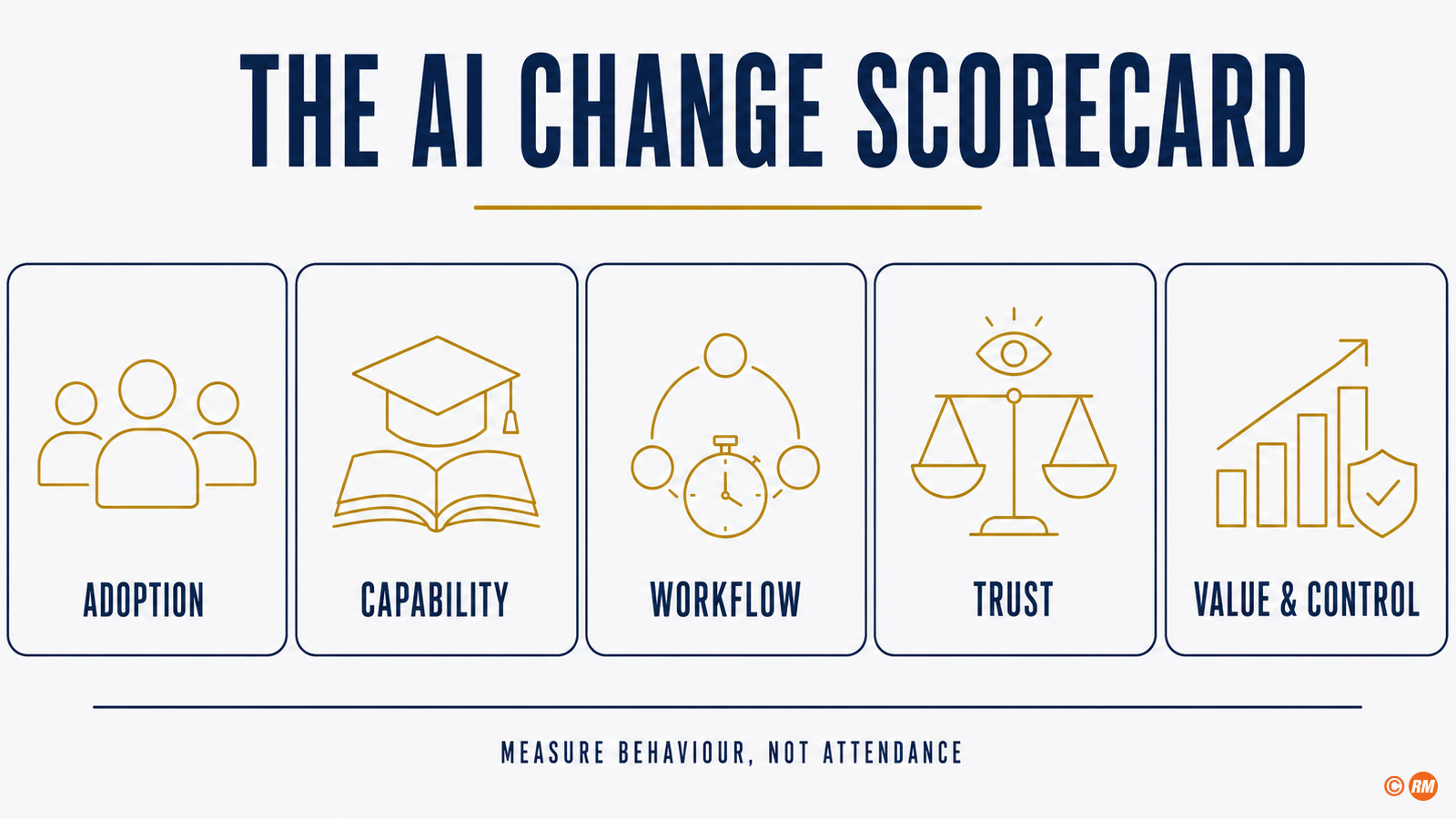
AI change management should be measurable.
A balanced scorecard can include five categories.
01Adoption Metrics
- Active users.
- Frequency of use.
- Use by role.
- Use by workflow.
- Drop-off rates.
02Capability Metrics
- Completion of role-based AI literacy.
- Practical assessment results.
- User understanding of limitations.
- Quality of human review.
- Escalation competence.
03Workflow Metrics
- Cycle time.
- Manual effort.
- Rework.
- Exception handling.
- Handoffs.
- Review burden.
04Trust and Oversight Metrics
- Override rates.
- False acceptance.
- False rejection.
- User confidence.
- Automation-bias indicators.
- Escalation quality.
05Value and Control Metrics
- Business outcome improvement.
- Control exceptions.
- Quality-assurance results.
- Risk events.
- Total cost of ownership.
- Risk-adjusted value.
- Benefits signed off by Finance.
- Control evidence reviewed by relevant control functions.
This measurement model prevents AI change from becoming a narrative exercise.
Conclusion: AI Change Management Is a People-and-Operating-Model Discipline
AI change management in financial services is not about persuading people to use AI.
It is about building the conditions under which AI can improve work safely, measurably and sustainably.
The evidence shows that AI can improve task performance in specific contexts. It also shows that effects are uneven. The same technology can increase productivity, reduce quality, create over-reliance, trigger rejection, improve learning or increase review burden depending on the task, user, workflow and control environment.
That is why AI change management must be treated as an operating-model discipline.
It requires role-based AI literacy, workflow redesign, trust calibration, human oversight, control by design, value measurement and lifecycle governance.
For European financial institutions, the practical direction is clear.
AI will not scale because tools are available.
AI will scale when people know how to use it, when workflows are redesigned around it, when governance can evidence control, and when boards can see that outcomes have changed.
A bank can buy AI tools, licences and platforms. It cannot buy the literacy, judgement and calibrated trust of its people.
Those must be built.
And building them is what AI change management is.